Showing posts with label Theory. Show all posts

Saturday, 22 February 2014

Best 40k novels

There is chick lit and there is fan lit and there is 40k lit. And there is lots of  other things lit. Sometimes these offerings from generally held these cliches transcend their genre. This blog offers no opinions on chick lit. As far as 40k goes opinions abound. The following is therefore a personal assessment.

The Ciaphas Cain series by Sandy Mitchell is definitely one of the best and easiest to read, but if unfamiliar with the 40k world it might be hard going except for the futuristic flashman with a large dose of insight. If unfamiliar with 40k taking it as SF with the internal monologue should allow it to continue to make sense.

Favourite and key character in this series is the indefatigable Jurgen, he of the body odour, webbing that contains everything, imperturbability in the face of certain horrible death in combat, but with a fear of flying and the ability to produce ready bowls of tanna anywhere and at any time, plus a handy multimelta. Jurgen is probably the real hero, Commissar Cain is the likable narrator despite and because of his admitted personal failings. Cain is sucked from one catastrophe to another, triumphing despite the odds and despite his penchance for running when the going gets only a little rough because of the ever present unquestioning support of the odorous and imperturbable Jurgen and his melta. If only GW would make a mini of Jurgen. Why is Jurgen not on the cover??

In addition as good a read is Ian Watson's Inquisition War trilogy taking in the Eldar. A complex and in some ways unsatisfying tale at the end.

In a similar vein is the amazing Dan Abnett Eisenhorn trilogy of Xenos, Malleus and Hereticus spanning all (is it really all) of the Inquistions flavours.This is the back story for the Inquisition and a must read for anyone wanting to deploy the Inquistion on the table top with any connection to the background story. 


Finally there is the Ravenor trilogy also written by Dan Abnett. Less reflective  and more action than the Eisenhorn trilogy but less weighty all the same.


Sunday, 1 December 2013

Inquisition Warband Build Flavours

The new digital Inquisition codex has been greeted with both acclaim and criticism. One thing is clear and that is few Imperial Forces will deploy without an Inquisitor and warband as additional allies. In addition the codex creates the possibility of all Inquisition armies with a primary inquisitorial detachment allied to another Inquisitoral detachment. Two Inquisitors pursuing different strands of investigation coming to the same conclusion. Given the firepower associated with the dedicated transports in the codex plus orbital strikes and psykic choirs, potentially seriously tough forces might be created. 

Some of the favourite minis here are Inquisitorial or Ecclesiarchial. So here is what might be constructed locally from some of the potential Inquisition minis on the shelves.

A small Inquisition Warband using Karamazov :

2x multimeltas, one plasma cannon and one acolyte with meltagun. Just needs a Jokaero to tweak the weapons. Karamazov has the relentless special rule and the
by any means necessary rule.

Or a small warband based on a generic Malleus Inquisitor :


3 servitors, one acolyte and a priest with a generic Malleus Inquisitor tooled up with power sword or force weapon, grimoir of true names, brain mines, power armour, and psyker level 1 with hammerhand - total 88 points for the Inquisitor and 59 for the warband if my arithmetic is correct, should be an ouch in close combat.

Tuesday, 16 July 2013

Painting Block - revisited and unlocked

A month or so ago some of these minis were pictured in this pose when painting block was blogged. Hopefully the picture shows that painting block has been over come. Don't know how however. Base coats on the Ogryns, Saint Celestine finished, the bases for the Seraphims sorted, the paint scheme on the grey blue chimera progressing to Steel Legion and the Steel Legion flamer mini progressing with base coats and 2 arms created from plastic minis and in addition a new steel Legion mini to complete the Steel Legion veterans. Only 2 more missile launcher teams to be recruited (via ebay since GW have ditched the Steel Legion) to complete the planned Steel Legion army. It will comprise an HQ squad with 2 platoons of 2 squads each with 2 heavy support squads for each platoon. And as a third troops choice a squad of veterans with an autocannon. For heavy support there is a Demolisher and for fast attack a single Bane Wolf plus 2 Chimera transports. obviously the armoured support needs to be expanded. Requires a bit of thought. Suggestions welcomed.   

Sunday, 6 January 2013

Battle Reports : How do you do it

GW is looking for a "cinematic feel" for playing a game of 40k. On the other hand the battle reports in White Dwarf have more of the feel of match of the day and a learning experience.

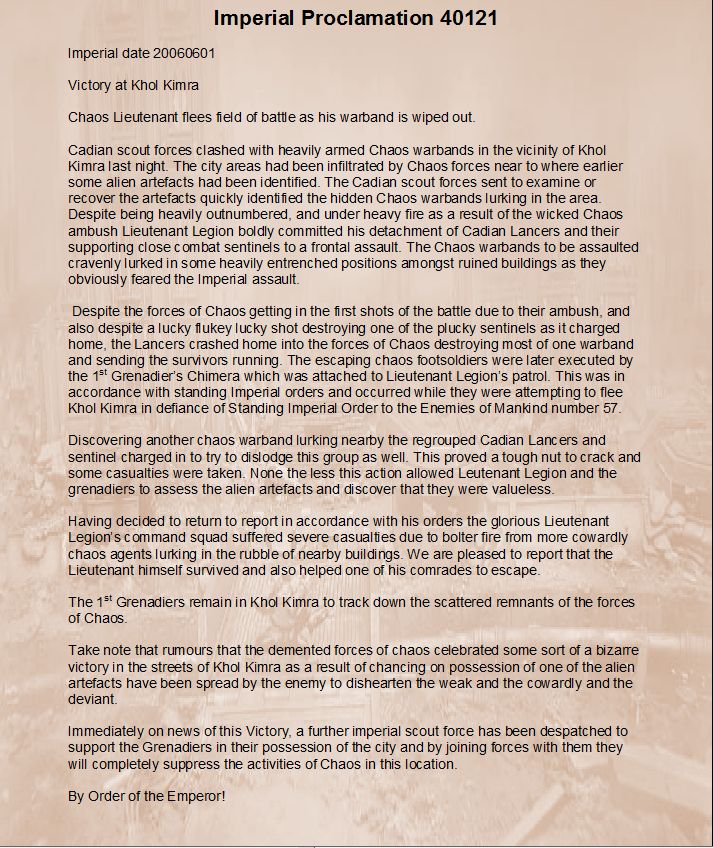
Here is a battle report from a local campaign. Each side was able to issue its own report. Can you tell which side won this particular battle.  The idea was to have some fun in the campaign and its off board milieu.

Easy question to answer actually. The question answers itself.


Is there a place for this type of fun reporting of 40k games?

Sunday, 30 December 2012

What is done and What is not done

Its near the end of 2012. So here it was thought that there should be a review of what had been completed. This thought was initiated by a review of posts being viewed yesterday. One from the list was titled project pipeline:- here  This was a post in 2011. And there has been little progress with the three projects mentioned therein.

But there has been progress elsewhere. 2012 has been the year when the Grey Knights project's shape took form and the Sisters of Battle and the Steel Legion projects came close to completion. Ideas in planning include an Ogre Warhammer army and a 40k minimal, veteran artillery allied army for the Sisters of Battle, more terminators for the Grey Knights, and some tweaks to the Steel Legion to add more special and assault weapons, plus of course the 3 projects still in the pipeline, and then there are still the Space Hulk minis to paint. Ideas come faster that the time available to paint, as ever.

Have a good 2013 when it comes and thanks for reading this blog.


Saturday, 3 November 2012

The Theory of Lucky Dice Rolls

What happens when you roll dice. You get a random result. Actually no. It's fractal.

 Everyone knows that for shooting by Imperial Guard with ballistic skill of 3 requiring a 4, 5 or 6 to means that 50% of shots should hit target. Why then can Imperial Guard shooting be so much worse than that? Perhaps you don't find that. Perhaps for you IG shooting is better than that 50-50 chance to hit. But dice rolls average out over 30 - 50 rolls so bad or good turns occur, unless the IG units are massed up.

Here is an experiment. Take 12 GW dice and roll them. As each number has an equal chance of occurring there should be 2x 1, 2x 2, 2x 3, 2x 4, 2x 5 and 2 x6. Six shots out of twelve should hit with for the IG. What did you get. Repeat the dice rolls and see what occurs.

Here is a set of genuine dice rolls done here, nothing has been made up:

Dice Value Roll 1 Roll 2 Roll 3
1 - - 1
2 3 5 4
3 3 2 2
4 4 2 4
5 - 2 -
6 2 1 1

It looks reasonably OK for IG shooting with 6 hits  for roll 1, 5 for rolls 2 and 3. But if these were saving throws with an expectation of 4 saves for 12 dice rolls it does not look so good with only 2 and 1 saves for rolls 1 and 3, and 3 saves for roll 2. Why is this.

The thing is that these rolls are not "random". Dice rolls are a self organising system. This means that the number of dice in the cup or hand, the force with which they are rolled, the surface they roll across, including anything they bounce off, the material the dice are made of, any wear and tear on the dice, the number of times they are shaken etc all go to make the result. Self organising systems make for a fractal pattern of numbers. Yes, numbers will trend to the expected over a large number of rolls but for rolling a small number of dice the fractal patterns of a self organising system predominate making for those "lucky" dice rolls. Its not luck, its not random its just unpredictable because the factors involved in rolling the dice are difficult to control.

What this means for the game is that units with small numbers of dice to roll are less dependable in the game. And if you can, roll as many dice as you can simultaneously to try to reduce fractal results and get close to the expected result.

If you like to gamble for a "lucky result" roll as few dice simultaneously as you can. Lady luck has no memory so the probability of getting any particular result depends completely on the circumstances each time - number of dice, amount of energy in the rolling, wear on the dice and surface rolled every time a dice is rolled 

Saturday, 13 October 2012

MathHammer vs chaos theory

The slippery fantasy of mathhammer is a crazy attempt to bend the random processes of probability to the will of the 40k gamer. Why should this be the case, especially as many players build their armies based on these arcane calculations? Basically the mathhammer player will have calculated given the toughness, weapons skill or ballistic skill that with so many models or with these or other upgrades the chance of a group of individual dice rolls getting a beneficial results is mathematically uprated. The assumption made in these mathematical systems is that probability smooths out over a certain number of dice rolls, say 20 or more rolls for a squad firing. This assumption is physically false in this universe at least. The rolling of dice is actually a self organising system, chaos theory. Each dice that is rolled has an individual probability or hitting a particular value, but the number of dice rolled at any one time does not influence the result on each individual dice. Self organising systems have specific characteristics which include the concept of avalanches. What this means for the game player is runs of good luck or more commonly runs of bad luck during the span of a game regardless of the mathhammer that has gone before. The averaging of dice rolls undoubtedly happens but only over the life span of the universe. Not over the span of a game of 40k. In the meantime dice rolls in individual games will defeat the odds again and again.

Mathhammer is therefore only a bit of headology that can give one or another player an advantage as long as they believe in mathhammer. At the end of the day a game of 40k pits on entity against another as does a battle pit one general against another.


There are undoubtedly other ways of applying a bit of headology to opponents quite legally through modelling, basing and playing skills.